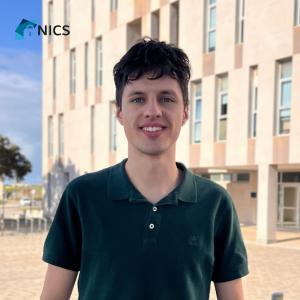
Héctor Guzmán
TECH & MNGT STAFF
Edificio de Investigación Ada Byron
C/ Arquitecto Francisco Peñalosa, nº 18
Ampliación Campus de Teatinos. Universidad de Málaga
29071 Málaga (Spain)
Phone: +34 951 952 916
E-mail: hectorga@uma.es
Publications
Cristina Alcaraz, Hector Guzman, Javier Lopez
Adaptive Digital Twin: Protection, deception, and testing
In: Future Generation Computer Systems, vol. 179, pp. 108357, 2026, ISSN: 0167-739X.
@article{Alcaraz2026a,
title = {Adaptive Digital Twin: Protection, deception, and testing},
author = {Cristina Alcaraz and Hector Guzman and Javier Lopez},
url = {/wp-content/papers/Alcaraz2026a.pdf
https://www.sciencedirect.com/science/article/pii/S0167739X2500651X?via%3Dihub},
doi = {10.1016/j.future.2025.108357},
issn = {0167-739X},
year = {2026},
date = {2026-06-30},
urldate = {2026-06-30},
journal = {Future Generation Computer Systems},
volume = {179},
pages = {108357},
abstract = {A Digital Twin (DT) is a cutting-edge technology that has gained relevance in recent years, demonstrating huge potential for the simulation of processes and the provision of valuable insights to improve and optimise systems. Leveraging a high degree of fidelity in replicating real-world processes, DTs are being explored for advanced applications such as deception and proactive protection of critical infrastructures. However, this same advantage also raises concerns with respect to a system’s exposure, as the detailed digital representation may introduce new cybersecurity risks. With the aim of assisting the growth of this technology, this paper presents an adaptive DT solution that facilitates the configuration of particular components of the digital system, tailoring different application scenarios specifically for protection, deception, and testing purposes. Finally, the proposed architecture is tested under a specific IoT-oriented use case to validate, experiment, and extract conclusions of the proposed solution.},
keywords = {},
pubstate = {published},
tppubtype = {article}
}
A Digital Twin (DT) is a cutting-edge technology that has gained relevance in recent years, demonstrating huge potential for the simulation of processes and the provision of valuable insights to improve and optimise systems. Leveraging a high degree of fidelity in replicating real-world processes, DTs are being explored for advanced applications such as deception and proactive protection of critical infrastructures. However, this same advantage also raises concerns with respect to a system’s exposure, as the detailed digital representation may introduce new cybersecurity risks. With the aim of assisting the growth of this technology, this paper presents an adaptive DT solution that facilitates the configuration of particular components of the digital system, tailoring different application scenarios specifically for protection, deception, and testing purposes. Finally, the proposed architecture is tested under a specific IoT-oriented use case to validate, experiment, and extract conclusions of the proposed solution.